How to Capture Reusable Event Testimonials and B-Roll for Future Promotion
Last updated: March 30, 2026
Most event teams leave with enough footage to recap the day, but not enough to help promote the next one.
They have keynote clips, room wides, applause, branding, and a few attractive cutaways. That may be enough for a highlights edit. It is often not enough for future promotion.
The problem usually appears later, when the organiser wants to market the next edition and realises there are very few usable attendee reactions, short testimonial clips, or flexible b-roll sequences that still work once the date has passed.
This article focuses on that narrower problem. Not event video strategy as a whole, and not a general guide to filming conferences, but what to capture on site if the footage needs to keep working beyond the immediate recap. That becomes much easier when the filming is shaped by a clear event video production plan.
Why recap footage is not enough
A recap video looks back. Promotion for a future event has to look forward.
That means the most useful footage is not just the material that records the running order. It is the material that shows what the event feels like, who is in the room, what kind of conversations are happening, and why the experience looks worth joining next time.
Many event shoots document the programme well enough. What they often miss is the proof needed for future promotion.
Start with the footage future promotion will actually need
If event footage may later be used to promote the next edition, the capture plan needs to reflect that before the day begins.
That does not mean turning the whole event into a promo shoot. It means being more deliberate about what will still be usable later. In practice, that usually means planning for concise reactions, evergreen atmosphere, audience engagement, networking, branded context, and enough visual variety to support different edits.
| What to plan for | Weak approach | Stronger approach |
|---|---|---|
| Future promo footage | Assuming the recap coverage will also be enough for next year’s promotion | Planning from the start for footage that can work beyond the event itself, including testimonials, atmosphere, engagement, and flexible b-roll |
| Whose voices to capture | Interviewing whoever happens to be available on the day | Choosing a useful mix in advance, such as attendee, speaker, sponsor, or broader event perspective |
| Contributor confidence | Approaching people cold with little context about what the footage is for | Letting contributors know how the video may be used, where it may appear, and how much time filming is likely to take |
| Testimonial capture on the day | Long setups, too many questions, and interviews that pull people away from the event for too long | Keeping the setup light, the questions concise, and the filming efficient so contributors can return quickly to the event |
| Useful visual coverage | Relying mainly on keynote footage, room wides, and generic applause shots | Capturing audience engagement, networking, branded context, and a mix of framing and movement that supports future edits |
A better plan starts by deciding whose voices you want, not just who happens to be free. It also means keeping testimonial capture efficient enough that contributors are not pulled away from the event for too long.
Ask questions that produce proof, not bland praise
Weak testimonial questions tend to produce vague approval.
Future promotion needs something more useful than “It was a great day.” It needs specifics people can believe.
It also helps to give contributors the gist of the topic without over-rehearsing them. Too much scripting can make a good answer sound flat.
| What you need | Weak question | Stronger question |
|---|---|---|
| A useful attendee reaction | How are you finding the event? | What has stood out to you so far, and why? |
| Proof of relevance | Has it been a good day? | What kind of conversations are happening here that feel genuinely useful? |
| A future-promo angle | Would you come again? | What would someone miss by not attending an event like this? |
| Clarity on who the event is for | Who do you think would like this? | What kind of person or team would get the most value from being here? |
| A natural-sounding answer | Can you say why this is an innovative and exciting event? | What felt most useful or memorable to you today? |
The best answers usually give future viewers something concrete to hold on to which includes relevance, value, audience fit, or a believable reason to attend.
Film b-roll that helps people picture themselves at the next event
Good promo b-roll does more than show that the event took place. It helps a future attendee imagine being there.
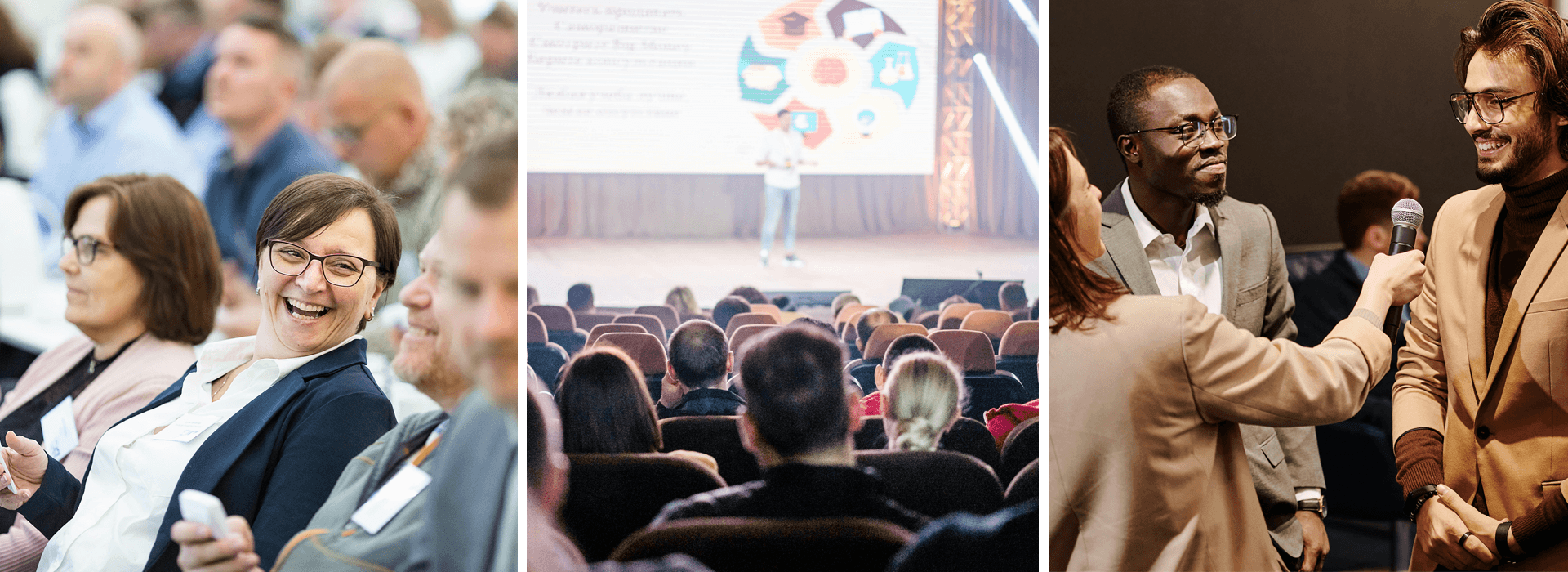
That usually means filming beyond the stage. Audience reactions, networking, branded detail, and broader atmosphere often do more for future promotion than keynote coverage alone.
| What to capture | Why it matters later | What to watch out for |
|---|---|---|
| Audience reactions during talks | Shows real engagement and helps future attendees believe the room was attentive, not just full | Avoid relying only on applause shots or repeatedly using the same type of reaction |
| Networking and informal conversation | Helps people picture the event experience beyond the stage and suggests practical value | Do not treat these moments as filler or capture them without any clear sense of interaction |
| Venue and branded detail | Adds polish, context, and recognisable identity to future edits | Too much year-specific signage can make the footage date faster |
| Wide, close, and establishing shots | Gives editors pace, flexibility, and enough variation to build multiple versions later | Too much of one framing style can make the footage feel repetitive or flat |
| General atmosphere footage | Useful across teasers, banner loops, cutdowns, and other future event marketing assets | Keep some of it evergreen rather than tying every usable shot to one specific date or message |
The strongest promo footage often answers a future attendee’s unspoken questions without spelling everything out. Will there be good people there? Will the room feel engaged? Will the day feel worthwhile?
Keep future-use footage as evergreen as possible
One of the easiest ways to improve the shelf life of event footage is to avoid tying every useful shot too tightly to one specific year.
That doesn’t mean ignoring the date. It means making sure the library also includes material that can still work later.
| Footage type | Less reusable approach | More evergreen approach |
|---|---|---|
| Branding | Heavy reliance on year-specific banners, dated supers, and campaign lines tied to one edition | A mix of branded context and broader visual identity that can still work later |
| Stage coverage | Slides, titles, and visuals that only make sense in the context of one year’s programme | Speaker presence, audience engagement, and moments that still make sense out of context |
| Atmosphere | Shots that only prove the event took place on a certain date | Transitions, crowd movement, networking, and venue detail that can support future promotion |
| Testimonials | Answers that talk mainly about this year’s schedule or one-off announcements | Answers that speak to value, audience, experience, and why the event is worth attending |
| Library value | A folder dominated by time-stamped material with limited later use | A balanced library containing both date-led coverage and footage that can support future edits |
If the organiser later wants to refresh dates, build a teaser, or reuse broader atmosphere footage, that extra flexibility matters.
Variety in shot choice makes the footage more useful
A strong event library is not only about what was filmed. It is also about how much choice the footage creates afterwards.
A mix of establishing shots, wides, close-ups, static frames, and movement gives the edit more pace and gives the client more options across different outputs.
| Shot type | What it adds | Risk if overused |
|---|---|---|
| Establishing shots | Sets the scene, gives scale, and helps the viewer understand the event environment | Too many can slow the pace or make the edit feel distant |
| Wide shots | Shows turnout, room energy, and the broader shape of the event | Can make different events look interchangeable if there is not enough variation |
| Close-ups | Brings intimacy, detail, and emotion into the edit | Can feel intrusive or repetitive, especially if people were not expecting to be featured prominently |
| Static shots | Creates visual stability and gives the edit moments to breathe | Can make the finished piece feel flat if there is too little movement elsewhere |
| Moving shots | Adds energy, pace, and momentum to promo edits | Can make the footage feel samey or overly stylised if everything moves in the same way |
There is a practical benefit too. If the event is filmed in 4K or 6K, selected stills can sometimes be pulled from the footage later if there was no dedicated photographer on site.
Hand over assets in a way that helps the client use them properly
A shoot becomes more valuable when the organiser understands what they now have.
That means the handover should go beyond one finished film and a folder of raw footage. In many cases, the most useful next step is a short explanation of the asset types now available and how they could be used later.
| What the client receives | Weak handover | Stronger handover |
|---|---|---|
| Main event film | One finished edit with little explanation of what else can be done with the footage | A finished edit plus clear guidance on how it fits into the wider content set |
| Testimonials | Interview footage buried in raw files with no indication of how it might be reused | Short testimonial clips or clearly identified interview sections that can be reused later |
| B-roll library | General footage delivered without context or suggested use | Evergreen b-roll identified as useful for teasers, silent loops, cutdowns, or later event marketing |
| Future-use guidance | No discussion of how the footage can support future campaigns or events | A short call or summary explaining how the footage can be used across longer edits, short clips, and other formats |
| Extra asset flexibility | No mention of additional options if no separate photographer was present | Where appropriate, pointing out that selected stills may be pulled from high-resolution footage |
Final thought
The most useful event filming does more than record what happened.
It captures the material that will still matter once the day is over.
For future promotion, that usually means thinking beyond the obvious recap shots and making time for concise testimonials, genuine reactions, flexible b-roll, and enough visual variety to keep the footage useful long after the event is over.
When that happens, the footage doesn’t just prove the event took place.
It helps sell the next one.