Storyboarding for Business Video: When You Need It
Last updated: March 15, 2026

Storyboarding can sound more formal than it really is.
For a lot of business video projects, it doesn’t mean drawing every frame or mapping every second in microscopic detail. In many cases, it simply means having a clear visual plan before the filming day begins.
That might be a rough sequence of key moments, a few must-have shots, an annotated script, or a simple storyboard deck that helps everyone understand what needs to be captured. The goal isn’t to make the planning look impressive. The goal is to make the production run more clearly.
That matters because many business videos don’t become difficult in the edit for technical reasons. They become difficult because key visual decisions were never properly made in pre-production. Within a broader approach to corporate video strategy for businesses, this is often where avoidable problems begin. One person imagines an interview-led film. Someone else expects a more polished brand piece. Important cutaways are assumed rather than planned. Then the crew arrives on the day and tries to solve it in real time.
A storyboard helps reduce that risk.
At its best, it answers a few practical questions early.
What is each part of the video trying to communicate?
What does the audience need to see at that moment?
Which shots are essential and which are optional?
What might only be possible to capture on that filming day?
Where could confusion, delay, or missed coverage creep in?
For many business clients, that kind of clarity is more useful than a highly polished document. The best storyboard is rarely the prettiest one. It’s the one that helps the right people make better decisions before production starts.
What storyboarding really means in business video production
Storyboarding is often mistaken for a highly detailed creative exercise that only suits large commercial shoots.
In business video production, it’s usually much more practical than that.
A storyboard helps bridge the gap between what the video wants to say and what the audience will actually see on screen. It turns a broad intention into something more usable. That doesn’t always mean a frame-by-frame plan. Sometimes it just means identifying the key visual pieces that need to be captured so the final edit can do its job properly.
That could include:
a location establishing shot
a product detail that supports a claim
a process moment that shows how something works
a customer or team interaction that adds proof
a visual sequence that makes the story easier to follow
This is where storyboarding earns its place. It helps stop important shots from becoming afterthoughts.
For example, if you know the entrance to a building, the reception area, or a branded exterior shot is going to help establish where the organisation is based, that may need to be captured on the filming day while you’re there. If nobody’s identified it beforehand, it may be missed, rushed, or forgotten. The same applies to process shots, product use, or moments involving people who are only available for a short window.
So in a business context, storyboarding is often less about artistic presentation and more about making sure the essential pieces of the puzzle are actually there.
Why pre-production matters more than many teams expect
A lot of the value of storyboarding sits inside a bigger truth.
Pre-production matters.
That may sound obvious, but it’s often the phase people are most tempted to rush. Filming feels like the real action, so planning can sometimes be treated as admin around the edges. In reality, the quality of the filming day often depends on the quality of the thinking that happened before it.
A simple way to think about it is this.
If you were arriving in a new city and needed to get to a coffee shop or a store you’d never visited before, you’d probably check a map first. You’d want to understand the route, the turns, and the best way to get there. You could still try to freewheel it and maybe arrive eventually, but it would probably take longer and involve more uncertainty.
Planning a business video isn’t all that different.
Without a clear route, you may still get to an end result, but the effort tends to become more drawn out. There’s more guesswork, more backtracking, and more room for missed opportunities. Pre-production helps make the journey more efficient and more purposeful.
That doesn’t mean everything must be locked down to the smallest detail. It means having enough structure that the production has direction.
Not every production needs a full storyboard
Not every production needs a storyboard, at least not in the traditional sense.
For simpler projects, a shot list, a clear brief, and a few notes on the visual direction may be enough. A straightforward interview-led update or a simple internal video may not need a detailed scene-by-scene board.
The better question is usually not “Do we need a storyboard?”
It’s “What level of visual planning will help this project most?”
| Project type | Planning level | What may be enough | Why |
|---|---|---|---|
| Simple internal update | Light | Brief, shot list, a few visual notes | The structure is straightforward and there is less risk of confusion |
| Interview-led business video | Light to medium | Annotated script plus must-have cutaways | The message is led by spoken content, but visuals still need planning |
| Branded film or mini documentary | Medium to high | Storyboard or clear storyboard deck | There are more visual beats, more interpretation, and more risk if key shots are missed |
| Multi-location or stakeholder-heavy project | High | Storyboard with practical production notes | More moving parts usually mean more need for alignment before filming |
Some productions only need a light structure. Others benefit from a fuller storyboard because there are more moving parts, more creative ambition, or less room for missed coverage.
That often includes:
longer branded pieces
mini documentaries
case study videos with several story beats
presenter-led videos that rely on key cutaways
projects with multiple stakeholders signing things off
shoots where certain locations or moments can only be captured once
In those projects, a storyboard can act as both a planning tool and a check. It helps the client and the production company stay aligned on the original idea, the intended storyline, and the main shots that need to appear in the final film.
That matters later in the edit as well. If the production has taken time to map the core visual journey early on, it becomes easier to see whether the final piece is following through on that original thinking.
Alternatives to a full storyboard for simpler projects
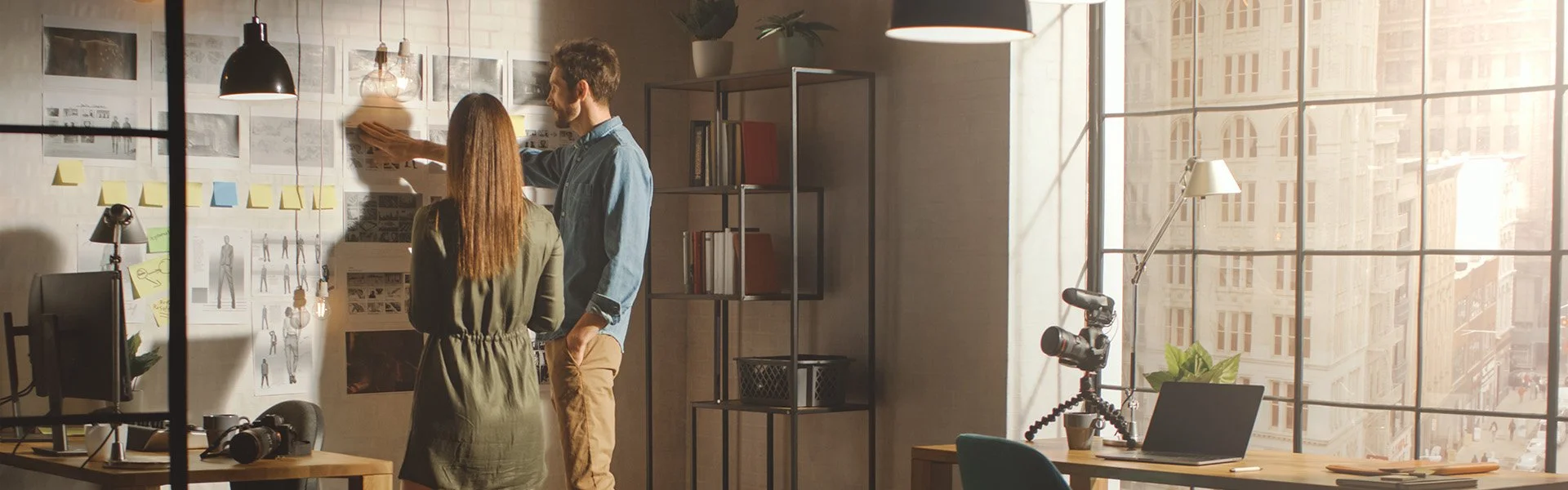
Example of a mood board used to align visual style before filming
Not every video needs a detailed storyboard.
For simpler productions, a lighter planning tool may be enough, especially when the structure is straightforward and the main priority is making sure essential coverage is captured.
That might be:
a shot list for interviews, demos, or simple sequences
a mood board for agreeing visual tone early
an annotated script where visuals, graphics, or cutaways sit alongside the wording
a simple visual plan that highlights the key scenes and must-have shots
The format matters less than the outcome. If the planning helps the team understand what needs to be filmed, what matters most, and what can’t be missed, it’s doing its job.
| Planning tool | Best for | What it helps with | Where it may fall short |
|---|---|---|---|
| Shot list | Straightforward interviews, product demos, and simpler shoot days | Makes sure essential coverage is captured efficiently | Does not always show how the sequence will feel in the finished edit |
| Mood board | Early visual direction and tone setting | Helps teams align on style, atmosphere, and references | Usually too broad to guide a filming day on its own |
| Annotated script | Message-led videos, voiceover pieces, and text-heavy edits | Connects spoken content to visuals, graphics, and edit notes | Can leave visual detail too open if the production is more complex |
| Simple visual plan | Projects that need clarity without a full storyboard | Keeps key scenes and must-have shots visible to everyone | May not give enough structure for more layered branded films |
Storyboard, shot list, or visual plan?
One reason this topic can get muddled is that different planning tools often overlap.
A storyboard is only one option.
Depending on the project, the visual planning may take the form of:
a storyboard with rough frames
a shot list organised by scene or priority
an annotated script with visual notes
a simple deck showing the key moments that need to be filmed
The format matters less than the usefulness.
If the plan helps people understand what must be captured and why it matters, it’s doing its job. If it looks polished but doesn’t guide the production in any practical way, it’s probably not solving much.
| Planning tool | Main use | Best fit | Where it may fall short |
|---|---|---|---|
| Full storyboard | Maps out the visual sequence of the video | Branded films, mini documentaries, and more layered business videos | Can be more detail than a simple project needs |
| Shot list | Identifies the shots that need to be captured | Interview shoots, event filming, and more straightforward productions | May not show how the story should unfold for the viewer |
| Annotated script | Connects spoken content to visuals | Voiceover-led or message-heavy content | Can still leave too much open to interpretation visually |
| Simple visual plan or deck | Highlights the key scenes or moments that matter most | Projects that need clarity without full storyboard detail | May not give enough guidance for more complex edits |
What makes a storyboard genuinely useful
A business storyboard doesn’t need to look polished to be useful. It needs to make decisions easier before the filming day.
The most useful ones usually do four things well:
show the purpose of each section
make clear what the audience needs to see
separate essential shots from helpful extras
reflect the practical reality of the shoot
If the script says a process is straightforward, the storyboard should show what proves that visually. If the message is about trust, it should be clear which moments, details, or interactions help support that.
It should also reflect real production conditions. That includes location limits, contributor availability, one-off moments, and anything that needs to be ready before filming begins.
A useful storyboard is not just a creative tool. It is also a practical check on whether the plan can actually be delivered.
A simple workflow that works in practice
Storyboarding works best when it happens after the message is clear, but before the filming day starts to carry too many unanswered questions.
A practical sequence often looks like this:
start with the brief
shape the message
identify the key visual beats
mark the must-have shots
add practical notes
review the plan before filming
If that early planning is still fuzzy, it usually makes more sense to strengthen the brief before trying to storyboard the execution.
For broader context on how this fits into the wider process, the video production process page is the natural companion.
Common mistakes with storyboarding in business video production
Most weak storyboarding tends to fall into the same traps:
being too vague about what needs to be captured
adding more detail than the project really needs
confusing visual style with visual clarity
leaving essential shots until the filming day
treating pre-production as optional
If a plan simply says “team in office” or “happy customer moment”, it usually is not specific enough to guide the production well. At the other end, an overly detailed storyboard can slow a simple job down without improving the result.
The goal is not maximum detail. It is enough clarity to help the team capture what matters.
Final thought
Storyboarding in business video production doesn’t have to be heavy, overbuilt, or overly formal.
Often, it’s simply the act of thinking ahead clearly enough that the important things don’t get missed.
Not every production needs a full storyboard. Some only need a clear plan, a few essential shots, and a shared understanding of what the final piece is trying to do. But when a project becomes longer, more branded, or more layered, storyboarding can be a very useful check. It helps make sure the production stays aligned with the original idea, the key storyline, and the footage the edit will depend on.
In that sense, storyboarding isn’t about adding unnecessary effort. It’s about making the effort more focused.