
Filming on London Streets: What Event Crews Need to Check Before the Shoot
Last updated: March 25, 2026
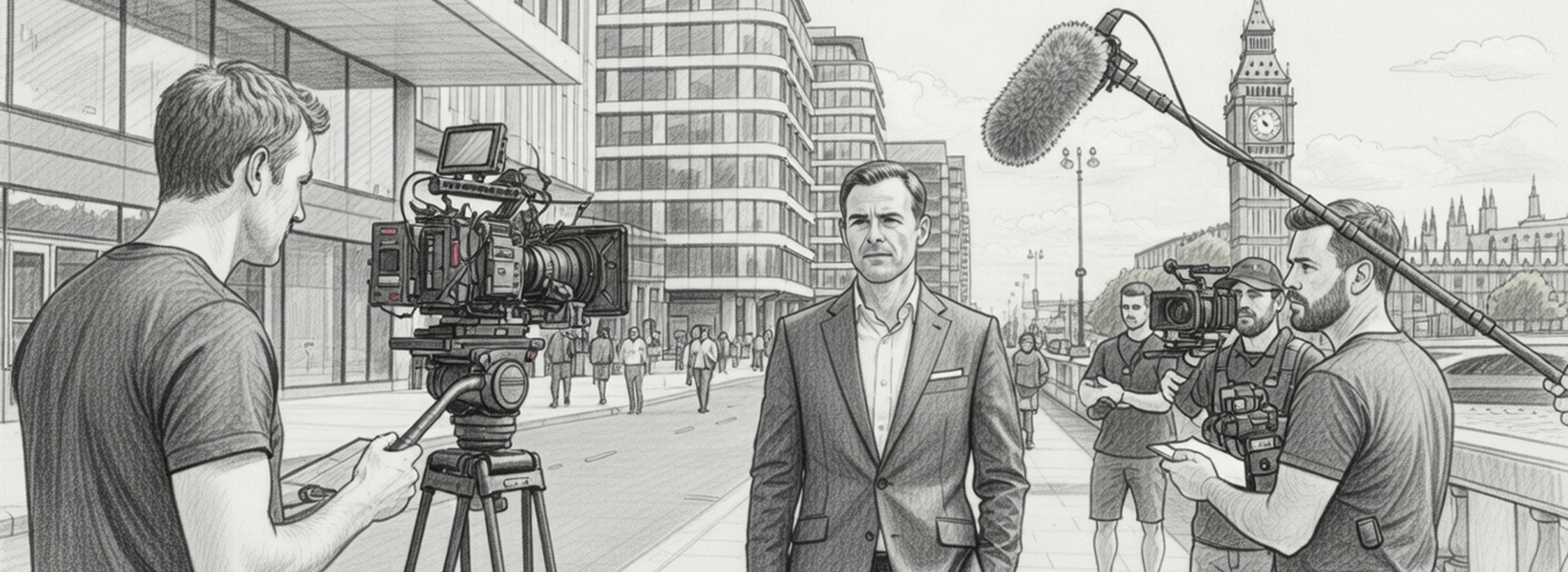
The question usually arrives after the schedule is already built.
A team has venue access, a presenter has ten spare minutes, and someone suggests grabbing a quick shot outside. Maybe it’s attendee arrivals on the pavement, a walk-up to the entrance, or a short piece to camera near the nearest station. It sounds simple until security intervenes, pedestrians start bunching around the kit, or the crew discovers that the bit of London that looked public is managed by someone else.
For event teams, that’s the real issue this page needs to solve. Not whether London is generally easy or difficult to film in, but whether a seemingly minor exterior setup is still a low-impact pickup or has quietly become a permissions problem. That’s why event video production planning for London shoots is worth getting right before the schedule starts to tighten around it.
Although the focus here is event filming, the same questions apply to plenty of other outdoor shoots in London too. Brand interviews, case-study filming, presenter-led content, and small commercial pickups can all run into the same issues once a crew steps into public-facing space.
The question event teams often ask too late
Most confusion starts with the wrong question.
People ask whether a street is public, as if that settles it. In practice, the better question is what your shoot is asking that space to tolerate. Film London’s small-crew guidance says that if you are using a handheld camera and your filming will not cause an obstruction, there is no restriction on filming on London’s public highway. It also says some boroughs extend that lighter-touch approach to small crews with a tripod, but strongly recommends informing the relevant Borough Film Service because crews can still be asked to stop if the authority is not aware of the shoot and a complaint is made.
That distinction matters more on event jobs than on many other shoots. Venue exteriors, delegate arrivals, sponsor clips, and presenter stand-ups often look too minor to treat as real production planning. In reality, they sit right in the zone where legal principle and practical permission are not always the same thing.
When small street filming is usually fine
There is a workable low-friction route in London, but it is narrower than many teams assume.
If the crew is genuinely small, the setup is handheld, and the filming does not obstruct the highway, the starting position is often straightforward. The practical problem is that “small crew” and “low-impact shoot” are not always the same thing. On an event day, the footprint grows quickly. A presenter stops for repeated takes. A producer steps onto the pavement. A sound operator shifts position. Cases go on the ground. The camera itself may still be small, but the shoot is no longer asking very little of the location.
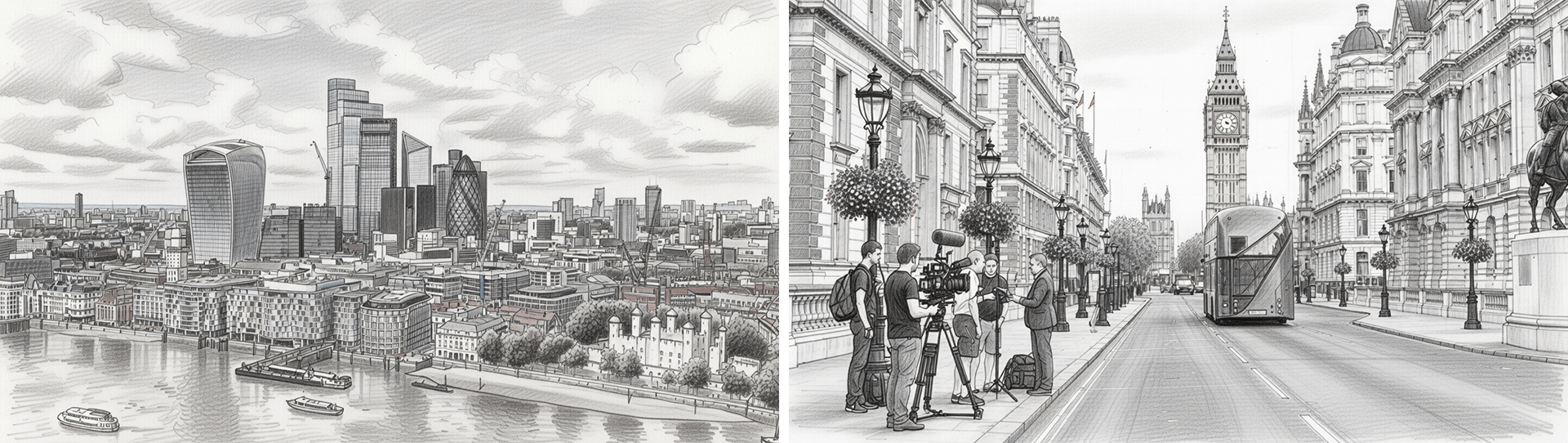
Filming in London often looks straightforward until location control, authority boundaries, and access rules start to vary from one space to the next.
What changes the permissions decision fast
Who actually controls the ground
A lot of London spaces feel public without being simple public highway.
Film London’s permissions guidance flags that some places with public access are still privately owned or separately managed, and specifically lists areas such as the Royal Parks, Trafalgar Square, Parliament Square, the South Bank, canal and river pathways, and train and Tube stations as places that always need filming permission. It also notes that filming the exterior of a building does not usually raise a copyright issue, but permission may still be needed depending on where the camera is physically placed.
That matters for event work because forecourts, plazas, attached squares, and approach roads often feel like part of the venue environment when they are not.
How much space your setup really takes
Most crews judge impact by intention. Boroughs judge it by footprint.
If filming is likely to cause an obstruction, Film London advises applying through the relevant Borough Film Service guidance. It also notes that Notices of No Objection do not give blanket protection if a shoot later creates an unforeseen obstruction. As a general rule, Film London says small crews should allow at least three days and large or complex shoots at least 10 days if a formal application is needed.
Westminster filming rules are a useful example of how specific this can get. Its no-application route only applies where the full on-street team is five people or fewer, equipment is handheld only, no equipment is stored on the pavement, and tripods are not used. Westminster states plainly that, unlike some other boroughs, tripods do not fall within that lighter-touch route.
Whether TfL or another authority is involved
This is where many “quick exterior” plans stop being simple.
TfL filming guidance says you need permission before filming or photographing on its network, including red routes, and that this applies regardless of subject, equipment, or crew size. It also directs productions to its red-route map so they can confirm whether the road they want is TfL-controlled or borough-managed. For network filming, TfL says permits are generally limited to off-peak periods on weekdays, with broader availability at weekends depending on location.
For event crews, that matters because arrival shots, venue approaches, and transport-heavy backdrops are often exactly where TfL control becomes relevant.
Whether the content changes the risk
Some shoots need extra notice because of what is being shown, not just because of the setup.
Met Police filming guidance says a police presence may be needed where filming raises public safety issues, shows crime enactments from a public place, involves liveried emergency vehicles or actors in police or modern military uniform, shows nudity or perceived nudity from a public place, uses visible or audible real or prop weapons, or involves low-loader or tracking shots on a public road. Its filming guidance separately lists categories likely to require police presence, including weapons, replica firearms, police uniform, fake police vehicles, scenes of crime or violence, real or perceived nudity, and public safety issues.
Use this as a quick location reference before you commit to a street setup:
| Location type | Typical permissions position | Main risk to check |
|---|---|---|
| Ordinary public pavement | Often workable for genuinely low-impact handheld filming | Obstruction, borough-specific rules, actual crew footprint |
| Venue forecourt or plaza | Do not assume public filming rules apply | Private ownership, site management, commercial restrictions |
| Station frontage or transport-linked area | Often requires separate permission | TfL control, security sensitivity, commuter flow |
| Park or landscaped public space | Usually separate from standard street rules | Park authority control, filming policy, public access conditions |
| Housing estate or council-managed site | Often requires borough or site-specific approval | Local authority rules, resident impact, equipment restrictions |
| Roadside on a red route | Higher-control environment | TfL approval, traffic impact, timing restrictions |
The event-coverage mistake that causes most problems
The most common misread is simple.
Teams assume venue permission extends to the space around the venue.
It often doesn’t.
A conference organiser may have cleared filming inside the event space. That does not automatically cover the pavement outside, the forecourt used for guest welcomes, the square next door chosen for a cleaner background, or the station approach where arrivals are being captured. Adjacent spaces often sit under different authority control or private management, which is why the permissions question needs to be checked against the exact ground the crew plans to use.
This is why the issue belongs in pre-production rather than being treated as last-minute admin. Once an exterior shot is tied to speaker availability, arrival flow, or a narrow gap between sessions, the crew is under pressure to force it through. That is usually when judgement gets worse.
For event filming, these are the setups most worth checking before the day:
| Common event setup | Likely permissions position | What to confirm first |
|---|---|---|
| Two-person handheld arrival shot on an ordinary pavement | Often workable without formal permission | True public highway, no obstruction, no managed forecourt, no red-route issue |
| Presenter piece to camera outside the venue with a tripod | Needs checking quickly, and may require formal approval | Borough rules, pavement clearance, crowding at entry points, exact venue boundary |
| Vox pops near a station or transport-heavy frontage | Higher-risk setup | TfL land, red routes, commuter flow, security sensitivity |
| Branded social clip in a plaza or forecourt that feels public | Do not assume yes | Who owns or manages the land, commercial-use restrictions, site security |
| Post-event pickup in a park near the venue | Separate rules often apply | Whether the location is controlled land, including Royal Parks or another managed site |
This comparison is a practical reading of Film London, Westminster, TfL, and Met Police guidance rather than a one-rule-fits-all answer. Borough rules and landowner controls still need checking against the exact location.
Once the location questions are clear, the next step is turning them into a workable shoot decision before the day is locked.
A quick pre-shoot check for exterior event filming
Before you lock the shot, run a short four-part check. Confirm who controls the exact ground where the camera, contributor, and any kit will stand. Then ask whether the setup is still genuinely low-impact, or whether it has become a managed shoot in all but name. Next, consider whether the crew could explain the basis for filming there confidently if challenged on the day. Finally, decide whether the shot is genuinely essential to the edit, or just a familiar convention that can be replaced.
If the answer points towards a formal permission route, build in enough lead time and assume that insurance and local approval may need to be part of the plan from the outset.
Proper production insurance should already be in place whether you are filming indoors or outside, but busy city locations make those basics harder to ignore. It is also worth staying alert to equipment security, bags, and the practical risks that come with moving through crowded public spaces with valuable kit.
That last editorial check is often the one that improves judgement most. A surprising number of exterior shots stay in the plan because they are habitual, not because they are doing meaningful work.
When a controlled location is the smarter call
Sometimes the strongest decision is not to push harder for the street shot.
If the exterior is central to credibility, it is worth clearing properly. If it is not central, and the setup is starting to need more time, more space, or more tolerance from the location than first expected, a more controllable London backdrop is often the better production decision. That is where a more controllable London venue often becomes the better option. Not because the street shot is impossible, but because the job may now need reliability more than spontaneity.
Bottom line
You do not need to treat every London exterior as a major permit exercise. But you also should not reduce the question to “public street equals fine”.
For event crews, the more useful judgement call is narrower than that. Who controls the ground, how much space the setup takes, whether another authority is involved, and how exposed the schedule becomes if the answer turns out to be no.
Even so, the broader lesson still holds beyond events. Once any outdoor shoot in London starts relying on public-facing space, the same mix of permissions, footprint, timing, and practical judgement starts to matter.
Before the call sheet is final, confirm the exact location owner, confirm whether the setup still qualifies as low-impact, and choose a fallback shot before the day begins. That is usually the difference between a smooth exterior pickup and the part of the schedule that starts to unravel.
Additional official guidance
| Resource | Best for | Who it suits |
|---|---|---|
|
|
Checking the official position where filming may involve red routes, stations, or other TfL-controlled locations | Teams planning exterior filming near transport links, venue approaches, or public-facing London locations where TfL rules may apply |
| Understanding how permissions can vary in central London, especially where public highway, private land, bridges, or traffic control are involved | Teams filming in the City or working in locations where land ownership, authority control, or local filming processes may be less obvious than they first appear |

Previous
Previous
Corporate Video Strategy for Businesses
Next
Next