Planning Authentic Corporate Video Content
Last updated: March 15, 2026
Authenticity gets talked about a lot in corporate video, but it often gets reduced to surface-level ideas. It can start to mean looser shooting, less polished visuals, or a speaker sounding informal on camera. None of those things, on their own, make a video feel real.
In practice, authentic corporate video comes from better judgement. It comes from giving people room to speak naturally, shaping the message around what matters to the audience, and resisting the urge to over-control every line, pause, and gesture. The result doesn’t need to feel rough. It needs to feel believable.
Viewers are good at spotting when a video is saying what a company wants said rather than what a person would naturally say. A polished finish can still work well. What tends to weaken trust is when the performance feels managed, the language feels inflated, or the edit becomes so clinical that the human presence starts to disappear. For businesses trying to improve planning, messaging, and format choices across their wider content, a stronger corporate video strategy for businesses often helps solve these problems earlier in the process.
What authentic corporate video actually means
Authentic doesn’t mean unplanned. It doesn’t mean rambling. It doesn’t mean leaving every take untouched.
For most businesses, it usually means:
the message is clear
the speaker sounds like a real person
the language fits the audience
the video stays focused
the production supports the message
the final edit still feels human
Some videos lose credibility not because they were too polished at the start, but because they were over-cleaned at the end. When every pause, breath, and small beat gets smoothed away, the person on screen can stop sounding present and start sounding processed.
Why some corporate videos feel polished but not convincing
A common problem is that too much attention goes into control and not enough into communication.
That usually shows up in familiar ways:
interviewees get coached into company-approved phrasing
scripts use language nobody would naturally say aloud
responses get padded with brand terms and keyword-heavy wording
edits become so tight that they lose warmth and rhythm
one video tries to do too many jobs at once
The result may still look professional, but it often feels slightly off. The tone feels managed. The speech feels formal in the wrong way. The person on screen seems to be performing certainty rather than sharing something genuine.
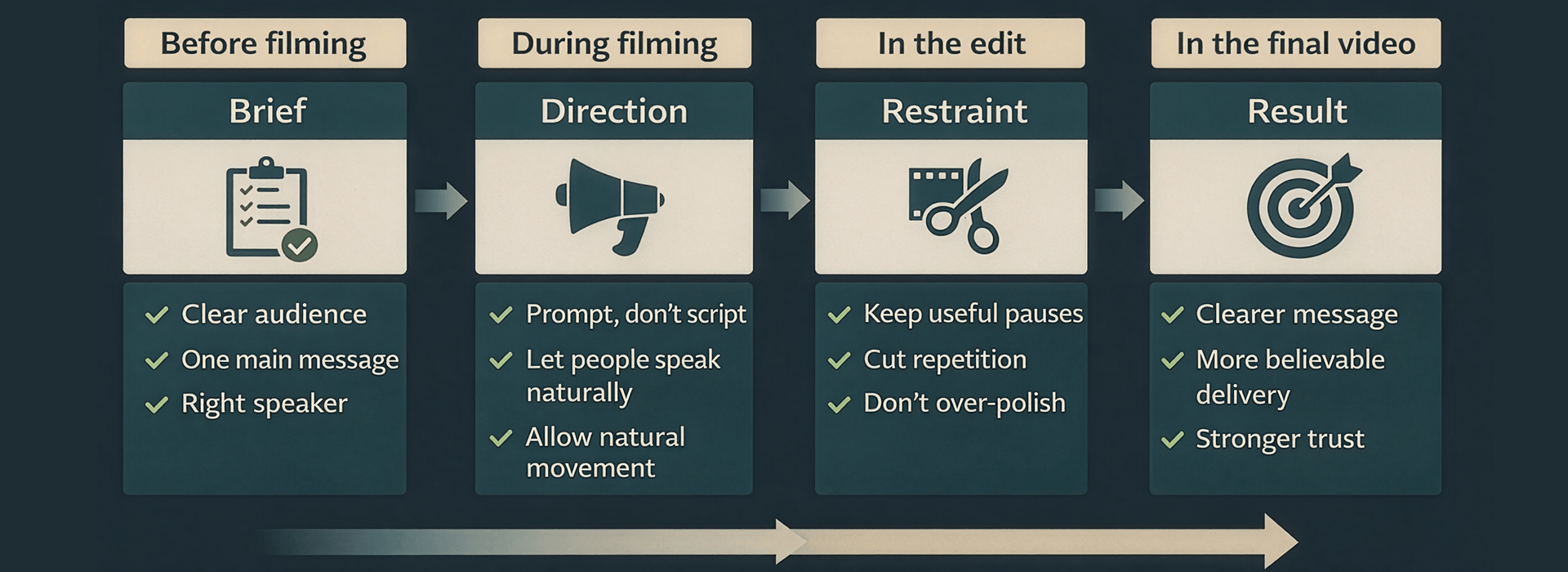
Authentic corporate video usually comes from clear planning, natural direction, and restrained editing rather than over-control.
The quickest ways authenticity gets lost
| What happens | Why it weakens the video | What usually works better |
|---|---|---|
| Exact lines are fed to contributors | It breaks confidence and flattens natural voice | Guide the point and ask follow-up questions |
| Formal or flashy wording takes over | It adds distance and makes delivery feel forced | Use clear language that suits the audience |
| Keywords and talking points get overpacked | The message becomes heavy and unnatural | Keep one focused message with room to breathe |
| Contributors are kept too stiff | Physical discomfort often affects delivery | Use a setup that helps the speaker relax |
| Every pause gets edited out | The final result can feel over-processed | Tighten the edit without stripping out human rhythm |
| The brief tries to cover everything | The script becomes crowded and vague | Be clear about audience, purpose, and format |
Let people speak naturally
One of the quickest ways to lose authenticity is to interrupt a natural answer and replace it with the line someone else wants spoken on camera.
This often happens when a contributor is speaking well, then a manager or stakeholder steps in and says, “Can you say it more like this?” Sometimes the wording is nudged. Sometimes the exact sentence is handed over to repeat back.
That may seem helpful, but it often changes the energy in the room straight away. Someone who was relaxed can become self-conscious. The interview stops feeling like a conversation and starts feeling like a test.
A better approach is to guide the point, not dictate the line. If an answer needs sharpening, it’s often enough to ask a follow-up question, narrow the focus, or prompt the speaker toward an example.
Don’t confuse formal language with authority
Some corporate videos weaken themselves by trying too hard to sound impressive.
When the script leans on inflated vocabulary or abstract phrasing, the speaker can sound less comfortable saying it. The viewer also has to work harder to get to the point.
Authority rarely comes from sounding complicated. In business video, it usually comes from sounding clear.
A useful check is simple:
would somebody actually say this out loud
would the intended audience understand it quickly
is the wording there to communicate rather than impress
If the audience needs plain speaking, the video should meet them there.
Don’t treat spoken video like a web page
Search visibility matters, but spoken content still needs to sound spoken.
There’s a growing temptation to treat video transcripts and captions as another place to push keyword signals. That often leads to lines being written for search patterns rather than for people. In practice, the rhythm goes, the contributor sounds less comfortable, and the message starts to feel forced.
If a piece of content needs the density of a white paper, it may be better off being a white paper. Video tends to work best when it brings clarity, tone, and human connection to the idea.
A shorter video that knows exactly what it’s there to do often does more than a longer one that tries to carry every talking point.
Natural movement matters more than people think
Authenticity isn’t only about words. It’s also about how people physically settle into the moment.
Some contributors speak better while standing. Others are more comfortable seated. Some need their hands free to explain something clearly. If the setup fights how somebody naturally communicates, the delivery often stiffens as well.
Natural movement can help with:
vocal ease
pacing
facial expression
confidence
clarity
overall comfort
That doesn’t mean letting the frame become messy. It means recognising that a bit of lived movement often feels more convincing than rigid stillness.
Authentic editing still needs restraint
Editing still matters. Repetition needs tightening. Wandering answers need shaping. But there’s a point where tidying becomes over-correction.
Some corporate videos become less believable because they’ve been polished too aggressively in post-production. Every breath gets clipped. Every gap gets shortened. Every hesitation gets treated like a flaw. The final result may feel efficient, but it can also feel oddly synthetic.
A balanced edit usually keeps:
natural pacing where it supports meaning
brief pauses that let a point land
small human beats that add warmth
clean structure without flattening the speaker’s voice
The goal isn’t to preserve every imperfection. It’s to avoid cutting away the signs that a real person is actually thinking and speaking.
A clearer brief usually creates a more authentic video
Many authenticity problems begin before filming starts. If the brief is vague, the messaging tends to become vague too. If the audience isn’t clear, the contributor often tries to talk to everybody. If the video is meant to do five jobs at once, the script usually becomes crowded and unnatural.
A more grounded approach starts with a few straightforward questions.
| Question before filming | Why it matters |
|---|---|
| Who is this really for? | It keeps the tone and detail level focused |
| What does the audience care about? | It stops the message drifting into internal language |
| What do they still doubt? | It helps the video answer a real concern |
| What one shift should happen after watching? | It stops the video trying to do everything at once |
| Who is the best person to speak on this? | It improves credibility and delivery |
| What should be shown rather than just said? | It makes the video feel more concrete and less abstract |
Those questions usually do more for authenticity than any stylistic trend.
Where AI can help, and where it can quietly hurt
AI can help with transcripts, captions, first-pass structure, idea sorting, and repurposing. Used well, that can save time.
But authenticity tends to suffer when AI starts shaping spoken tone too heavily, especially if the result becomes more formal, more stuffed, or more generic than the speaker would ever be in real life.
AI can support the process. It shouldn’t replace judgement about how a person actually sounds.
Final thought
Authentic corporate video doesn’t come from trying to look effortless. It comes from making better choices at every stage.
It comes from letting people speak in their own words. It comes from resisting bloated language. It comes from recognising that movement, pacing, and small pauses are part of real communication. It comes from tightening the message without sterilising it.
When a corporate video feels authentic, it usually isn’t because nothing was shaped. It’s because the shaping was done with restraint.